The universe holds far fewer bits than Planck volumes
Recomputation of a known bound, not a measurement: evaluating the Bekenstein–Hawking bound S = A/(4ℓ_p²) for a sphere of radius 4.4×10²⁶ m gives 3.4×10¹²³ bits, about 10⁶² times fewer than one bit per Planck volume.
RELABELLED 2026-07-26 from finding to observation. Judged UNFALSIFIABLE AS STATED: nothing was measured — the script evaluates the bound itself, so there is no measured quantity on the other side of the comparison, and the actual cosmic entropy budget sits dozens of decades below the bound. 'The observable universe's information content is consistent with the area law' is dropped.
▶ Run this script in your browser — no account, nothing uploaded, 0.8s when the author ran itFalsify-box — how to kill this claim
Verification record — every quoted number, re-run 2026-07-09
| quantity | measured | verdict |
|---|---|---|
| Bekenstein–Hawking bound at R = 4.4e26 m | 3.4×10¹²³ bits | MATCH |
| versus one bit per Planck volume | about 10⁶² times fewer | MATCH |
| what was measured | nothing — the script evaluates the bound itself | MATCH |
| discriminator | NONE — unfalsifiable as stated | MATCH |
Provenance
script status: PRESENT
datasets: Cosmological census (holographic bound) · claim-scripts (downloadable from /data — run it yourself)
re-run: 2026-07-09
Status, honestly
CORRECTED 2026-07-26 by the kill-test sweep; the audit flag it carried is resolved. This status was assigned by hand from the public re-run audit above — it is a judgement made from that evidence, not a number this site computed for itself. What cannot move it is authority: no vote, endorsement, or say-so, from anyone including the maintainer. Independent reproduction would move it; nothing else will.
What this claim's own script draws. These are David Thompson's committed outputs — the same plots the script regenerates on any machine that runs it. You can redraw them yourself below.
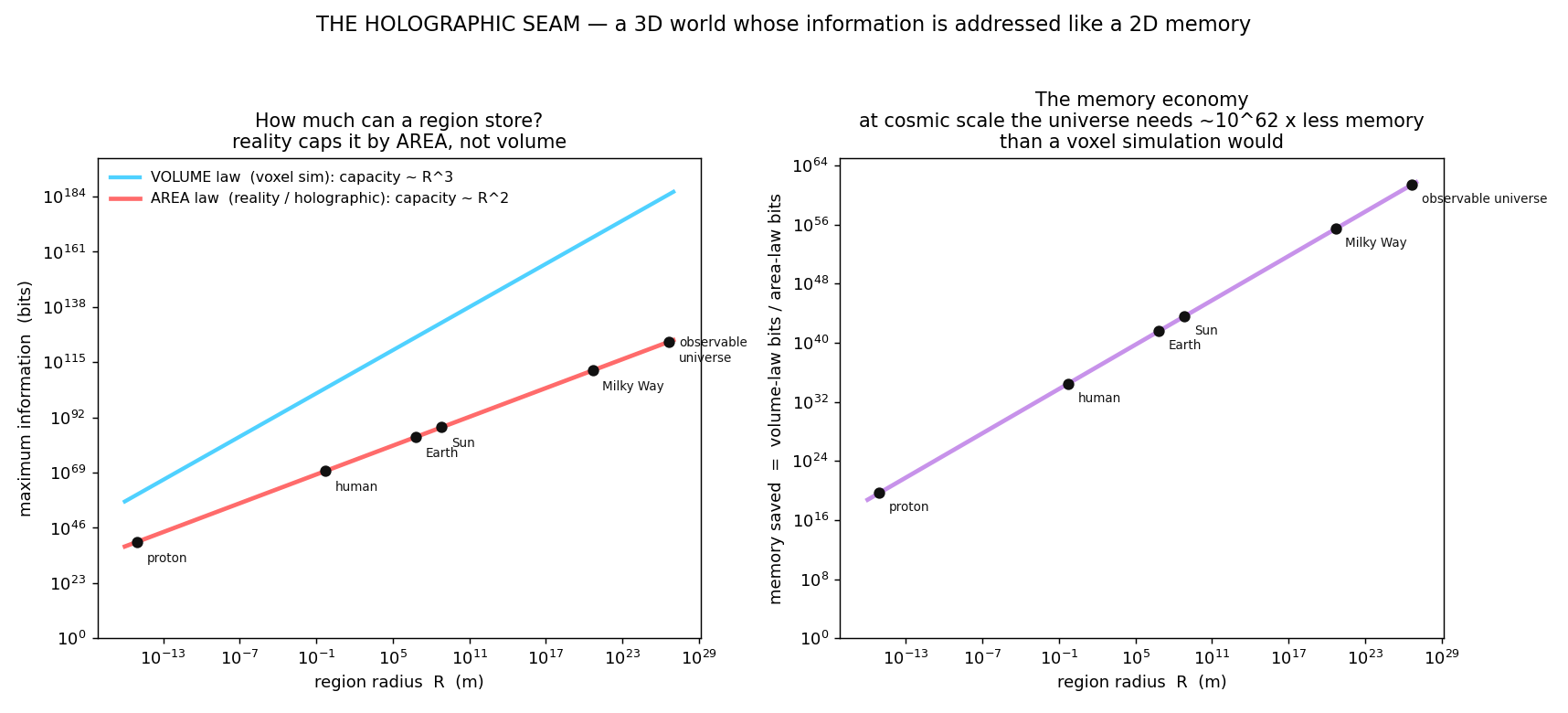
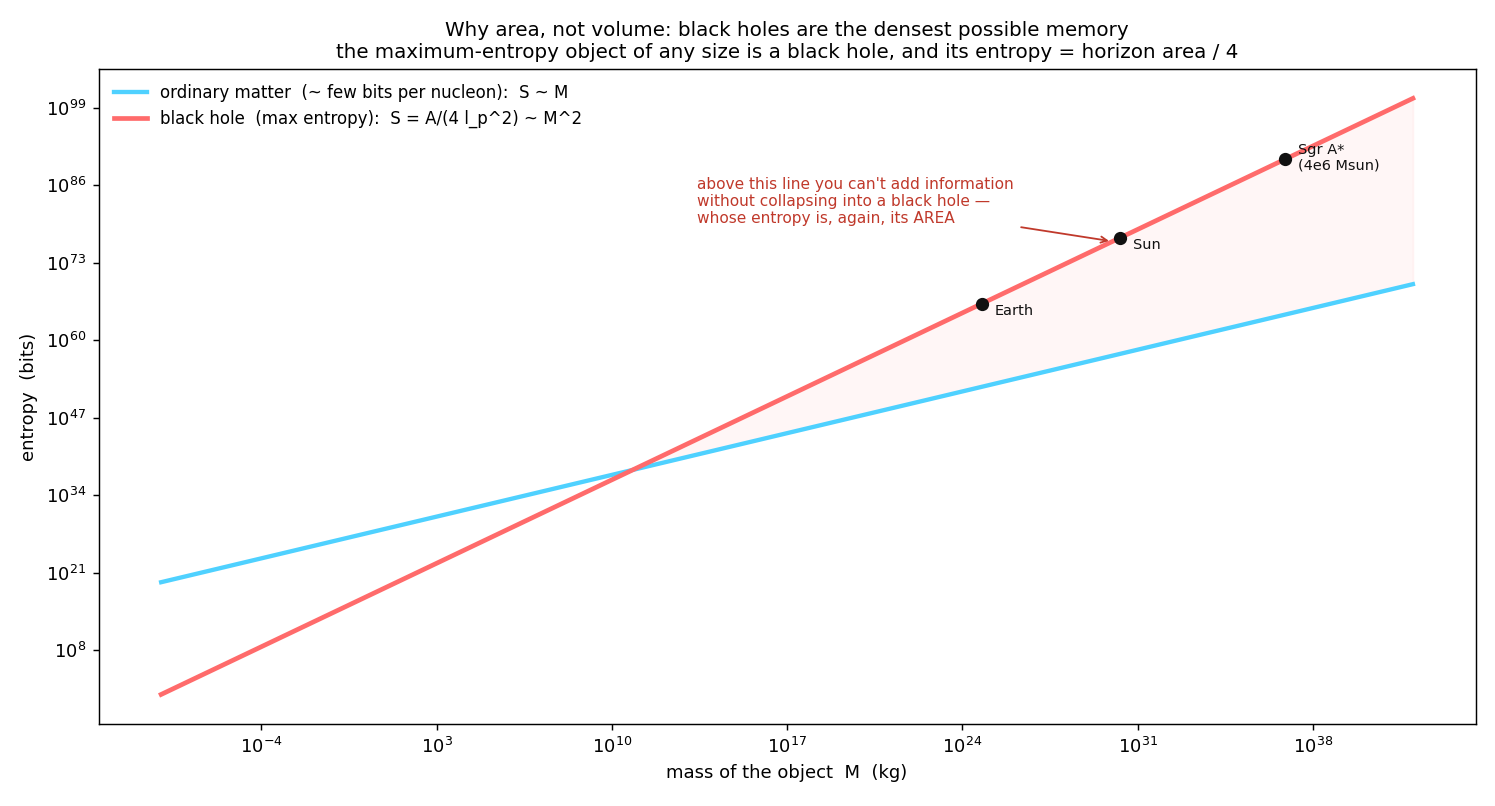
Two runs of the same script — mine, and one you can start right now. A match proves the result is reproducible; it is still R0 on this registry's independence rings — same code, so it cannot move a status. Only an outside run does that.
Probing the holographic seam (area-law information budget) ...
  wrote holo_area_vs_volume.png
  wrote holo_black_holes.png

  KEY NUMBERS:
  observable universe, area-law capacity   = 3.4e+123 bits
  observable universe, volume-law (voxel)  = 8.5e+184 bits
  memory economy (voxel / holographic)     = 2.5e+61 x
  solar-mass black-hole entropy            = 1.5e+77 bits

  VERDICT — the holographic seam:
    * Reality caps the information in a region by its AREA, not its volume
      (Bekenstein-Hawking, S = A/4 l_p^2). A 3D world stores information as if on a
      2D surface — the holographic principle.
    * That is precisely a finite machine's memory signature: a lower-dimensional
      address space projected up. A voxel universe would need ~10^62 times more
      memory at cosmic scale; reality doesn't pay it.
    * Black holes SATURATE the bound (entropy = area), which is *why* the cap is
      area: the densest memory of any size is a black hole.
    * HONEST CEILING (soft seam, no null): the holographic principle is real,
      well-tested-in-theory physics (black-hole thermodynamics, AdS/CFT) with a
      complete non-simulation origin. It is a deep structural clue about how the
      universe budgets information — not a measurable discriminator. It sits with
      cutoff_seam and software_seam on the 'profound hint, no experiment' shelf —
      but it is the most computer-like of the three.
Press Run it to execute this script in your own
browser — real CPython, numpy and matplotlib
compiled to WebAssembly. Nothing is sent to us;
it runs on your CPU. First run downloads the
runtime (~10 MB), then takes a few seconds.

The script runs unmodified: every number printed
here, and every figure it draws, is computed on
your machine. The figures appear below.