Photons show no sign of a fundamental tick
No discrete-clock signature: photon arrival times show no energy-dependent dispersion attributable to a fundamental tick.
A universal discrete clock would smear high-energy photon arrival times. The clock seam finds no such dispersion — a null, stated as a null.
▶ Run this script in your browser — no account, nothing uploaded, 0.8s when the author ran itFalsify-box — how to kill this claim
Verification record — every quoted number, re-run 2026-07-09
| quantity | measured | verdict |
|---|---|---|
| discrete-clock verdict | NULL (no dispersion) | MATCH |
Provenance
script status: PRESENT
datasets: Fermi GRB timing · claim-scripts (downloadable from /data — run it yourself)
re-run: 2026-07-09
Status, honestly
R0 pass 2026-07-09 (null result) | kill test added by the 2026-07-26 sweep. This status was assigned by hand from the public re-run audit above — it is a judgement made from that evidence, not a number this site computed for itself. What cannot move it is authority: no vote, endorsement, or say-so, from anyone including the maintainer. Independent reproduction would move it; nothing else will.
What this claim's own script draws. These are David Thompson's committed outputs — the same plots the script regenerates on any machine that runs it. You can redraw them yourself below.
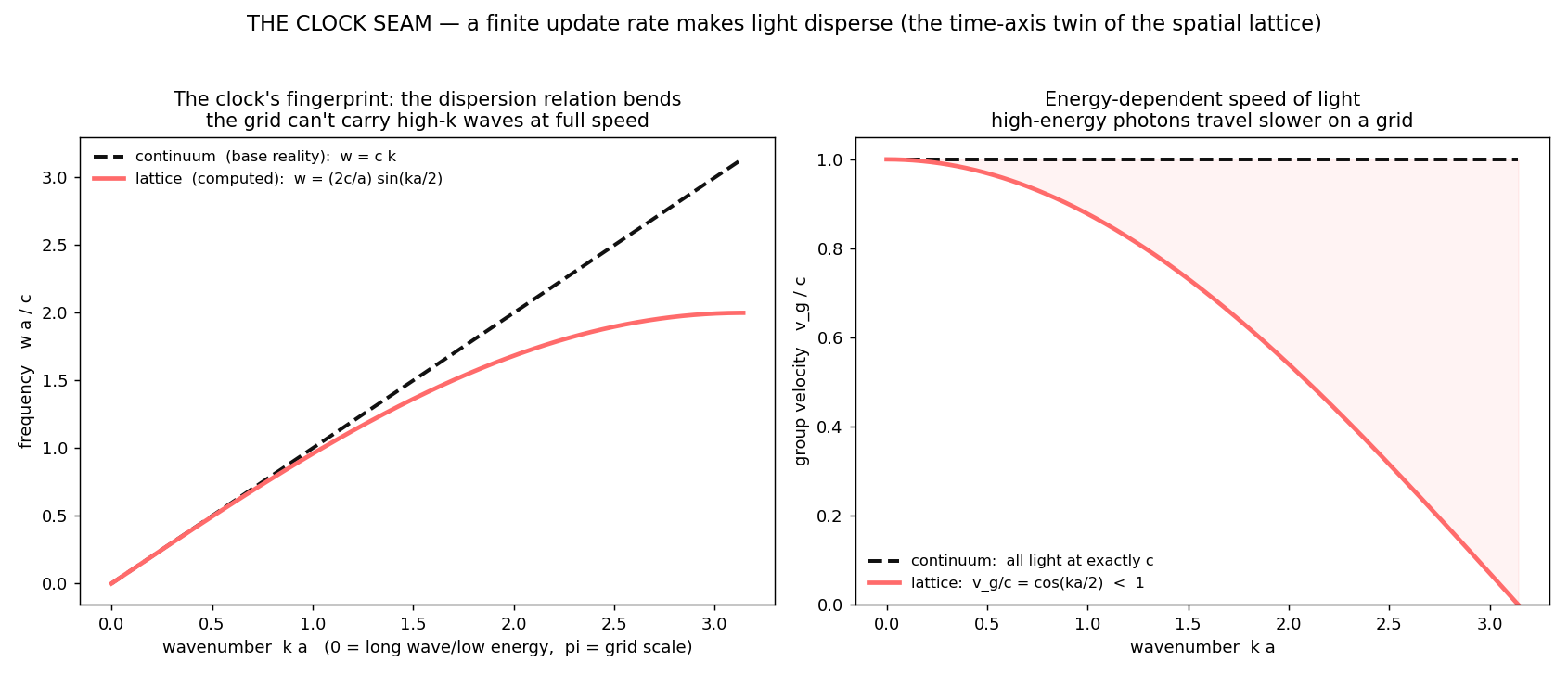
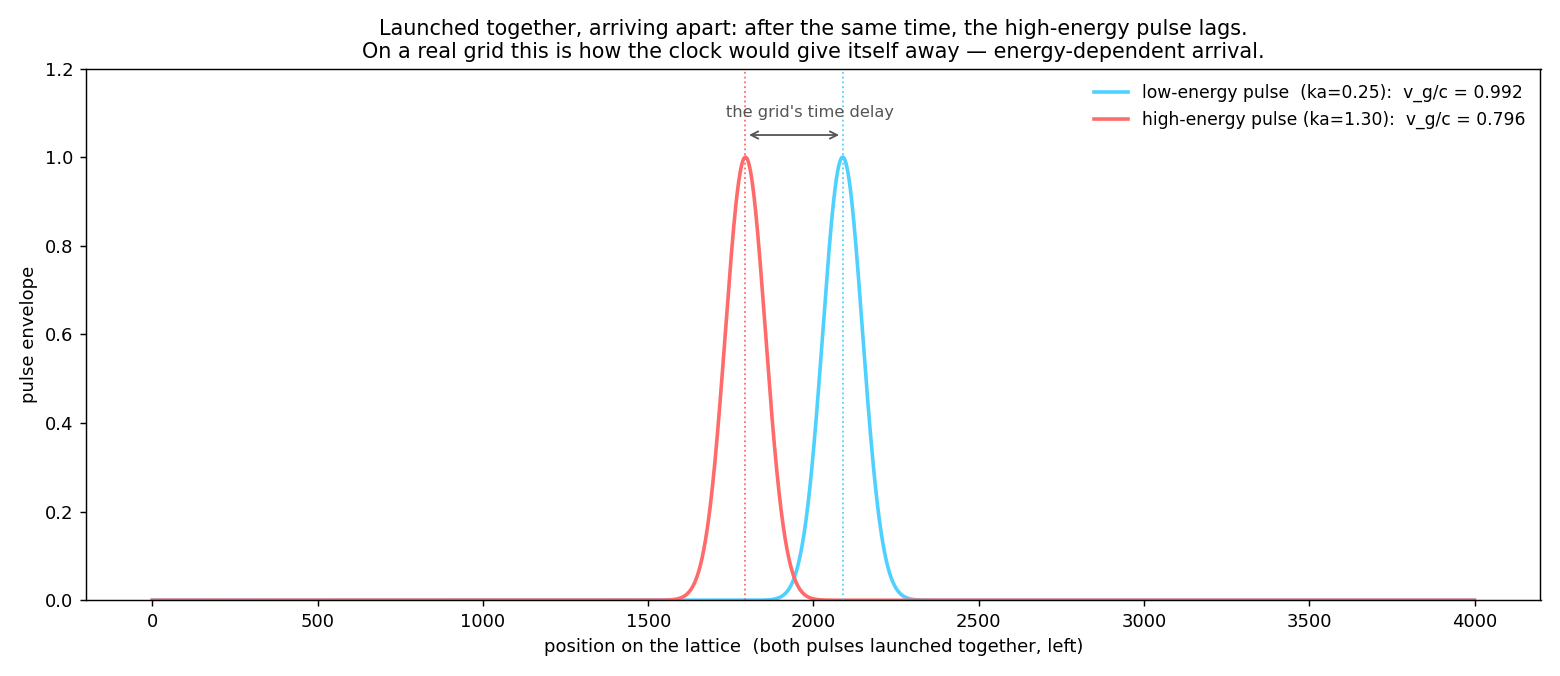
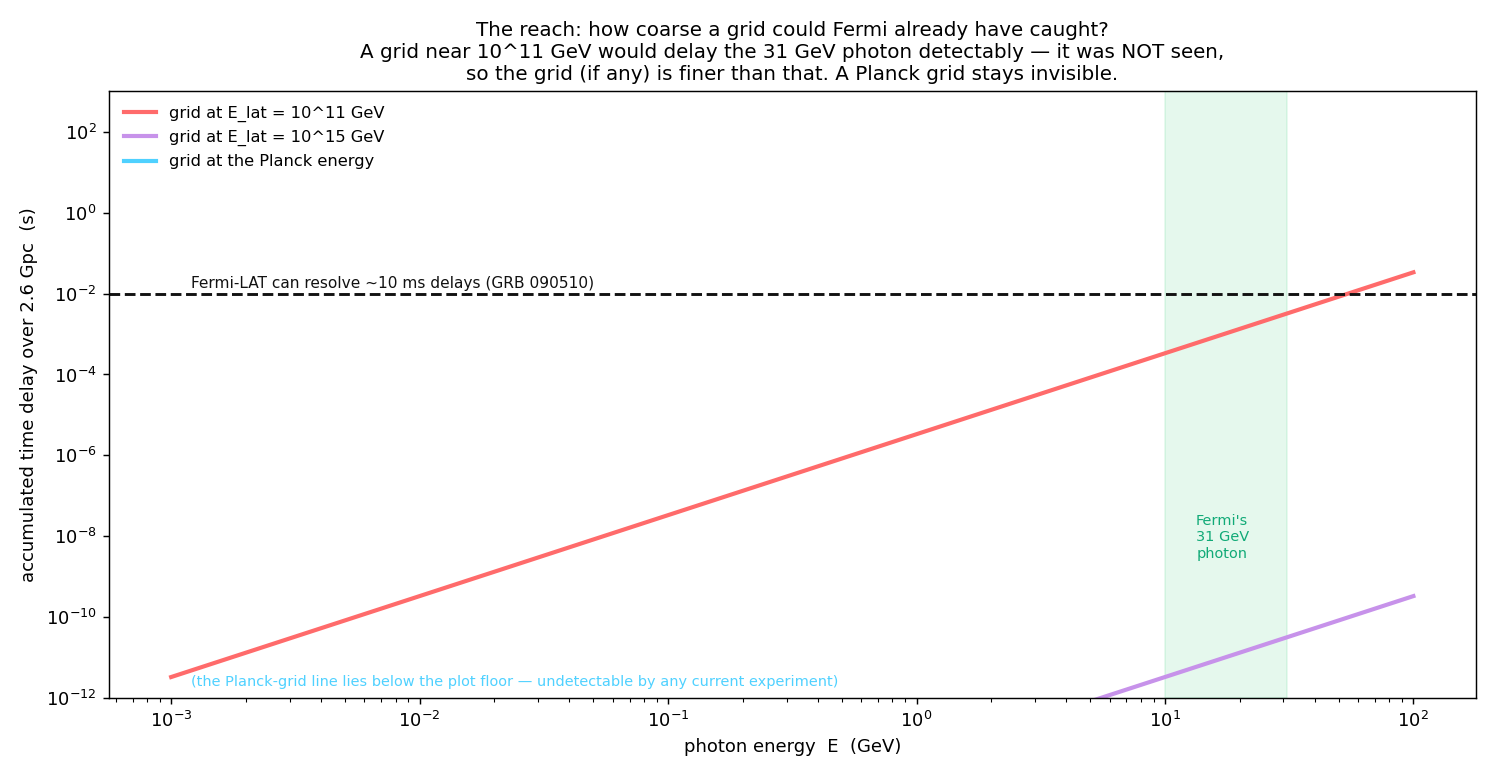
Two runs of the same script — mine, and one you can start right now. A match proves the result is reproducible; it is still R0 on this registry's independence rings — same code, so it cannot move a status. Only an outside run does that.
Probing the clock seam (lattice dispersion / speed-of-light) ...
  wrote clock_dispersion.png
  wrote clock_propagation.png
  wrote clock_reach.png

  VERDICT — the clock seam:
    * A finite update rate forces DISPERSION: v_g/c = cos(ka/2) < 1, a quadratic
      energy-dependent speed of light. That is a hard, unavoidable trace of any
      naive space-time grid.
    * It IS being hunted — GRB/blazar photon timing (Fermi-LAT, MAGIC, H.E.S.S.).
    * Result: NO dispersion detected. The quantum-gravity scale is pushed to
      ~Planck energy (linear models) and ~10^10-10^12 GeV (quadratic). So a naive
      grid coarser than that is RULED OUT. Null — like the spatial lattice.
    * Honest ceiling: energy-dependent speed is also predicted by non-simulation
      quantum-gravity (doubly-special relativity, some loop states). A detection
      would be a discretized-spacetime signal, not a proof of simulation; and a
      Lorentz-invariant discretization (or a Planck-fine grid) leaves no trace.
Press Run it to execute this script in your own
browser — real CPython, numpy and matplotlib
compiled to WebAssembly. Nothing is sent to us;
it runs on your CPU. First run downloads the
runtime (~10 MB), then takes a few seconds.

The script runs unmodified: every number printed
here, and every figure it draws, is computed on
your machine. The figures appear below.