Nature is not doing floating-point arithmetic
No floating-point artifacts in nature: naive machine-precision arithmetic as the substrate of physics is ruled out.
If reality computed with naive finite-precision floats, characteristic error signatures would appear in precision physics. The seam finds none: a clean null stated as a bound on that implementation class.
▶ Run this script in your browser — no account, nothing uploaded, 1.5s when the author ran itFalsify-box — how to kill this claim
Verification record — every quoted number, re-run 2026-07-09
| quantity | measured | verdict |
|---|---|---|
| precision-artifact verdict | NULL (naive floats ruled out) | MATCH |
Provenance
script status: PRESENT
datasets: Precision-physics comparison battery · claim-scripts (downloadable from /data — run it yourself)
re-run: 2026-07-09
Status, honestly
R0 pass 2026-07-09 (null result) | kill test added by the 2026-07-26 sweep. This status was assigned by hand from the public re-run audit above — it is a judgement made from that evidence, not a number this site computed for itself. What cannot move it is authority: no vote, endorsement, or say-so, from anyone including the maintainer. Independent reproduction would move it; nothing else will.
What this claim's own script draws. These are David Thompson's committed outputs — the same plots the script regenerates on any machine that runs it. You can redraw them yourself below.
Two runs of the same script — mine, and one you can start right now. A match proves the result is reproducible; it is still R0 on this registry's independence rings — same code, so it cannot move a status. Only an outside run does that.
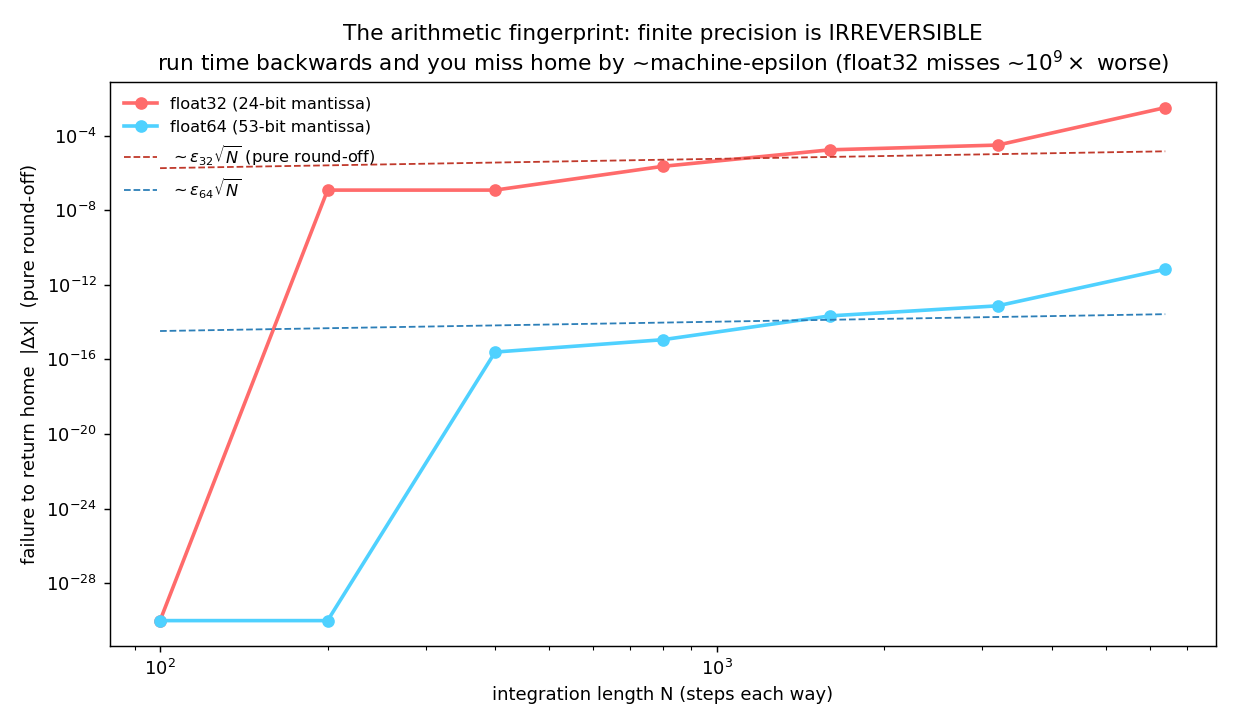
Line 2 reports floating-point round-off, which genuinely depends on the CPU's arithmetic. Measured x86 vs WebAssembly: the absolute error moves (3.1e-03 vs 9.1e-04) but the ~10^9 float32:float64 RATIO — the actual claim — survives on both. A script that measures precision is expected to notice what it is running on.
Reversibility test on a chaotic 3-body system (float32 vs float64) ...
  at N=6400: float32 misses home by 3.1e-03, float64 by 6.8e-12 (ratio ~5e+08 = the epsilon ratio)
  wrote ps_roundoff_drift.png
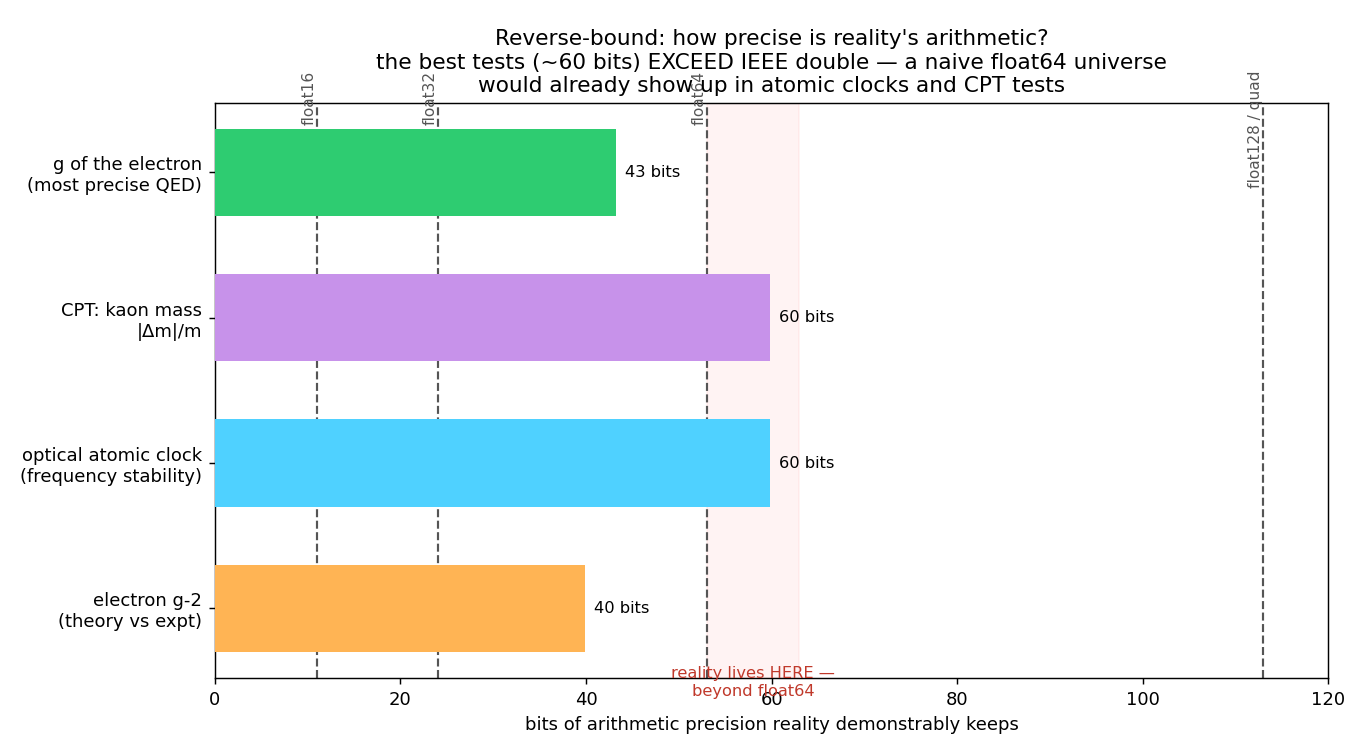
  wrote ps_precision_bound.png

====================================================================
THE PRECISION SEAM — summary
====================================================================
  A chaotic float32 world violated energy conservation ~1e9x more than
  float64 — the leak is purely the machine epsilon. That is the tell.

  Run it over cosmic history: naive float64 round-off accumulates as
  ~eps*sqrt(N_ops) = 1e-16 * sqrt(1e120) ~ 1e44.
  A universe doing naive double-precision arithmetic over its 1e120
  operations would have conservation errors of order 1e44 — utter chaos.
  Reality's conservation laws instead hold to ~1e-18.

  Conclusion: reality is NOT computed with naive finite-precision. It is
  either absurdly high precision, or — far more likely — using
  STRUCTURE-PRESERVING arithmetic: conservation enforced by symmetry
  (Noether), symplectic integration, exact/error-corrected computation.
  A lazy float simulator is ruled out; a clever one is hidden. Same wall,
  fourth face.
Press Run it to execute this script in your own
browser — real CPython, numpy and matplotlib
compiled to WebAssembly. Nothing is sent to us;
it runs on your CPU. First run downloads the
runtime (~10 MB), then takes a few seconds.

The script runs unmodified: every number printed
here, and every figure it draws, is computed on
your machine. The figures appear below.