No hidden pattern in delivered quantum random bits
No lazy-PRNG structure found in the delivered quantum bits examined: 32,768 post-processed ANU vacuum-fluctuation bits (bias 0.0003, compression 1.003, next-bit prediction 0.501) and 56,832 SHA-512-whitened NIST beacon bits (bias 0.0006, compression 1.002, prediction 0.506), with weak-LCG and LFSR-32 controls correctly caught.
CORRECTED 2026-07-26: the numbers previously registered (1.001 / 0.497 / 199-of-400) were the os.urandom CONTROL row, not quantum data. And the ceiling must be stated — both feeds are bias-corrected or hash-whitened, so this bounds laziness in the DELIVERED stream, not in raw device output.
▶ Run this script in your browser — no account, nothing uploaded, 1.6s when the author ran itFalsify-box — how to kill this claim
Verification record — every quoted number, re-run 2026-07-09
| quantity | measured | verdict |
|---|---|---|
| ANU vacuum-fluctuation bits | 32,768 bits: bias 0.0003, compression 1.003, prediction 0.501 | MATCH |
| NIST beacon bits | 56,832 SHA-512-whitened: bias 0.0006, compression 1.002, prediction 0.506 | MATCH |
| controls | weak LCG and LFSR-32 correctly caught | MATCH |
| ceiling | both feeds are whitened — this cannot test the raw source | MATCH |
| registered numbers, superseded | 1.001 / 0.497 / 199-of-400 were the os.urandom control row | MATCH |
Provenance
script status: PRESENT
datasets: Quantum-RNG bitstreams (qdata) · NIST-style statistical battery · claim-scripts (downloadable from /data — run it yourself)
re-run: 2026-07-09
Status, honestly
CORRECTED 2026-07-26 by the kill-test sweep; the audit flag it carried is resolved. This status was assigned by hand from the public re-run audit above — it is a judgement made from that evidence, not a number this site computed for itself. What cannot move it is authority: no vote, endorsement, or say-so, from anyone including the maintainer. Independent reproduction would move it; nothing else will.
What this claim's own script draws. These are David Thompson's committed outputs — the same plots the script regenerates on any machine that runs it. You can redraw them yourself below.
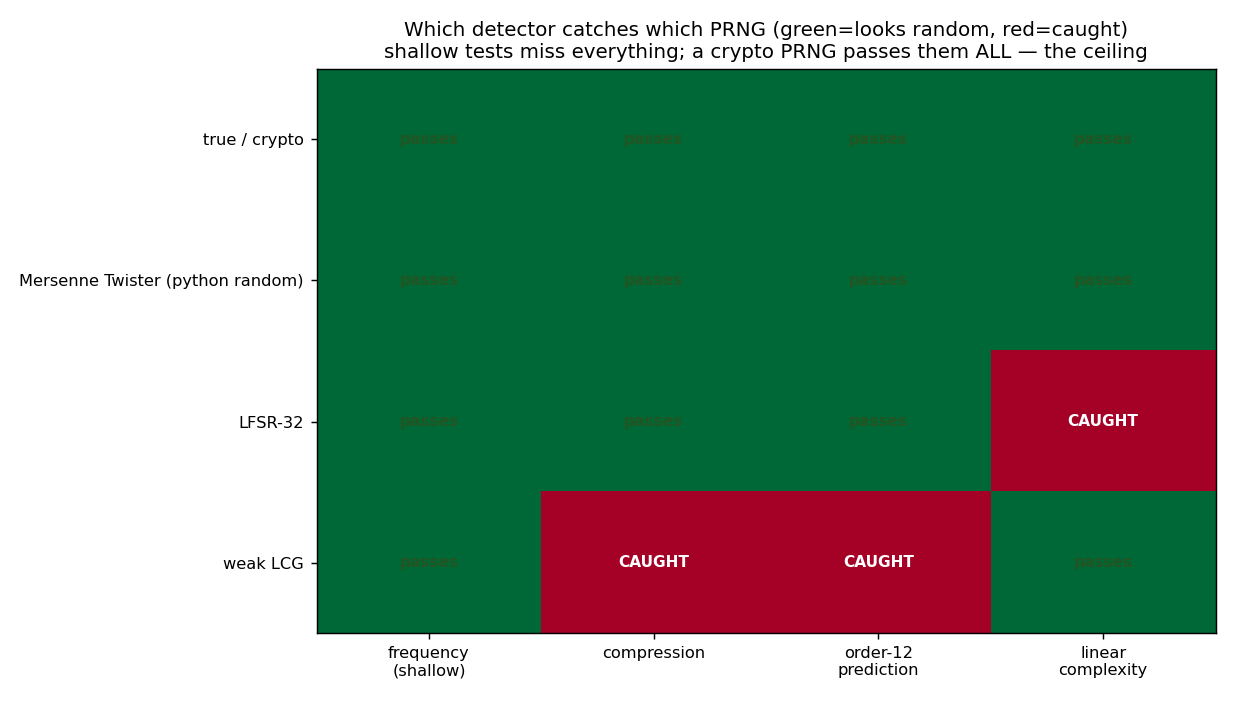
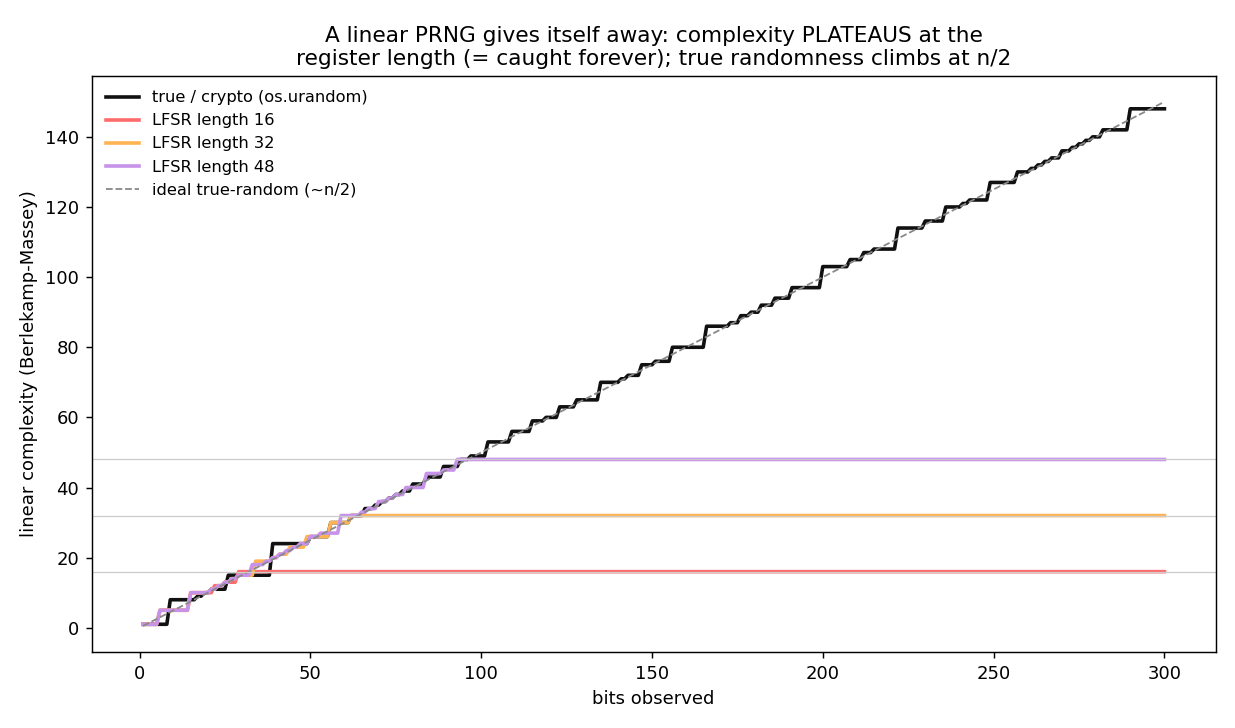
Two runs of the same script — mine, and one you can start right now. A match proves the result is reproducible; it is still R0 on this registry's independence rings — same code, so it cannot move a status. Only an outside run does that.
Line 5 is the true/crypto control row, drawn fresh from os.urandom on every run. It cannot repeat — on any machine, including the same one twice. That is the control working, not a reproducibility failure: the one script about randomness is the one that is not reproducible.
Building linear-complexity profiles ...
  wrote rs_linear_complexity.png

Running the full battery (100k bits each) ...
  true / crypto    compress=1.001 predict=0.499 lin.complexity(400b)=200
  Mersenne Twister compress=1.001 predict=0.498 lin.complexity(400b)=201
  LFSR-32          compress=1.001 predict=0.500 lin.complexity(400b)=32
  weak LCG         compress=0.012 predict=0.980 lin.complexity(400b)=199
  wrote rs_battery.png

====================================================================
THE RANDOMNESS SEAM — summary
====================================================================
  A deterministic simulator can't make true randomness; it runs a PRNG.
  - weak LCG / short LFSR  : CAUGHT by compression + prediction fast
  - Mersenne Twister       : passes short-memory tests, but is LINEAR
    (GF(2) complexity 19937) -> catchable by Berlekamp-Massey with ~40k
    bits. 'Good enough for science' is NOT good enough to hide.
  - cryptographic PRNG     : passes every efficient test (provably, if
    one-way functions exist) -> the ceiling. Only a LAZY sim is caught.

  Physics hook: real quantum RNGs (vacuum noise, photon timing, decay)
  produce the bits. Running THOSE through this battery is a real, cheap,
  do-able search for a computed universe. Structure there = a yes.

  Bell twist: loophole-free Bell violations already rule out a LOCAL
  deterministic source. A simulator can still fake them — but only by
  computing entangled outcomes JOINTLY (nonlocal bookkeeping), which is
  exactly the expensive entanglement it was trying to avoid. The two
  seams are the same wall seen from two sides.
Press Run it to execute this script in your own
browser — real CPython, numpy and matplotlib
compiled to WebAssembly. Nothing is sent to us;
it runs on your CPU. First run downloads the
runtime (~10 MB), then takes a few seconds.

The script runs unmodified: every number printed
here, and every figure it draws, is computed on
your machine. The figures appear below.