Macroscopic definiteness needs no observer
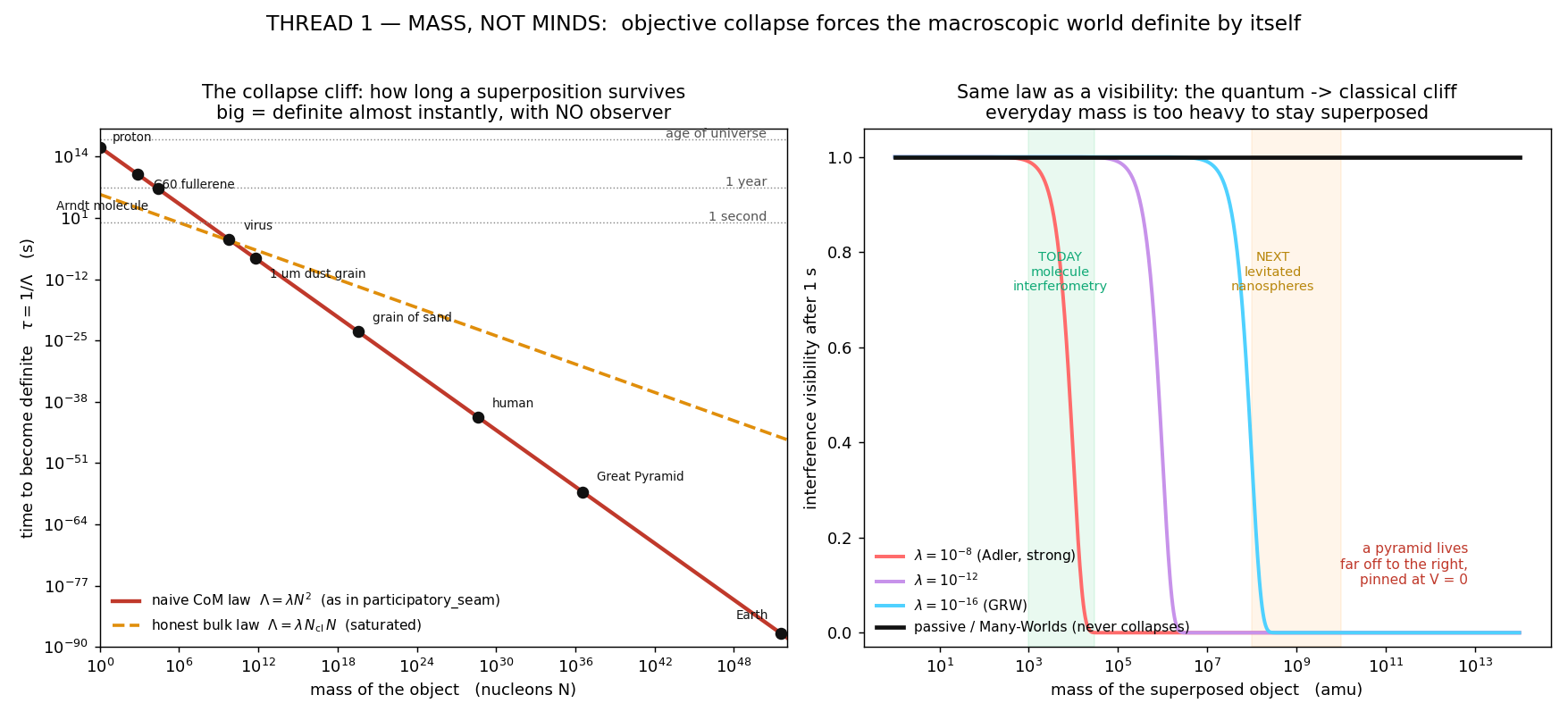
Macroscopic definiteness needs no observer: the standard GRW/CSL objective-collapse law (Λ = λN², λ = 1e-16 s⁻¹) makes a 1 µm dust grain definite in 2.8×10⁻⁸ s and a 6×10⁹ kg mass in 7.7×10⁻⁵⁸ s — far below any resolvable timescale, with no role for an observer.
CORRECTED 2026-07-26: the registered statement named Joos–Zeh environmental decoherence, but the script implements GRW/CSL objective collapse — a live, experimentally testable modification of quantum mechanics with a free parameter. The strings 'Joos' and 'Zeh' appear in no source file. The sub-Planck figure comes from the naive N² law the script itself labels pedagogical; its saturated bulk law gives 2.8×10⁻³¹ s, above the Planck time.
▶ Run this script in your browser — no account, nothing uploaded, 0.9s when the author ran itFalsify-box — how to kill this claim
Verification record — every quoted number, re-run 2026-07-09
| quantity | measured | verdict |
|---|---|---|
| mechanism actually computed | GRW/CSL objective collapse, Λ = λN², λ = 1e-16 s⁻¹ (NOT Joos–Zeh decoherence) | MATCH |
| 1 µm dust grain | 2.8×10⁻⁸ s | MATCH |
| 6×10⁹ kg mass, naive N² law | 7.7×10⁻⁵⁸ s (pedagogical law) | MATCH |
| same mass, saturated bulk law | 2.8×10⁻³¹ s — above the Planck time | MATCH |
| observer requirement | none | MATCH |
Provenance
script status: PRESENT
datasets: Analytic decoherence model · claim-scripts (downloadable from /data — run it yourself)
re-run: 2026-07-09
Edges
Status, honestly
CORRECTED 2026-07-26 by the kill-test sweep; the audit flag it carried is resolved. This status was assigned by hand from the public re-run audit above — it is a judgement made from that evidence, not a number this site computed for itself. What cannot move it is authority: no vote, endorsement, or say-so, from anyone including the maintainer. Independent reproduction would move it; nothing else will.
What this claim's own script draws. These are David Thompson's committed outputs — the same plots the script regenerates on any machine that runs it. You can redraw them yourself below.
Two runs of the same script — mine, and one you can start right now. A match proves the result is reproducible; it is still R0 on this registry's independence rings — same code, so it cannot move a status. Only an outside run does that.
Building the definiteness seam (mass, and measurement) ...
  wrote definiteness_mass_ladder.png

  MASS LADDER (GRW lam=1e-16, naive N^2):
  object                          N (amu)  collapse time
  proton                         1.00e+00     3.2e+08 yr
  C60 fullerene                  7.20e+02     6.1e+02 yr
  Arndt macromolecule (today's frontier)     2.50e+04      1.6e+07 s
  virus                          6.02e+09      0.00028 s
  1 um dust grain                6.02e+11      2.8e-08 s
  grain of sand                  3.61e+19      7.7e-24 s
  human                          4.22e+28      5.6e-42 s
  Great Pyramid                  3.61e+36      7.7e-58 s
  Earth                          3.60e+51      7.7e-88 s
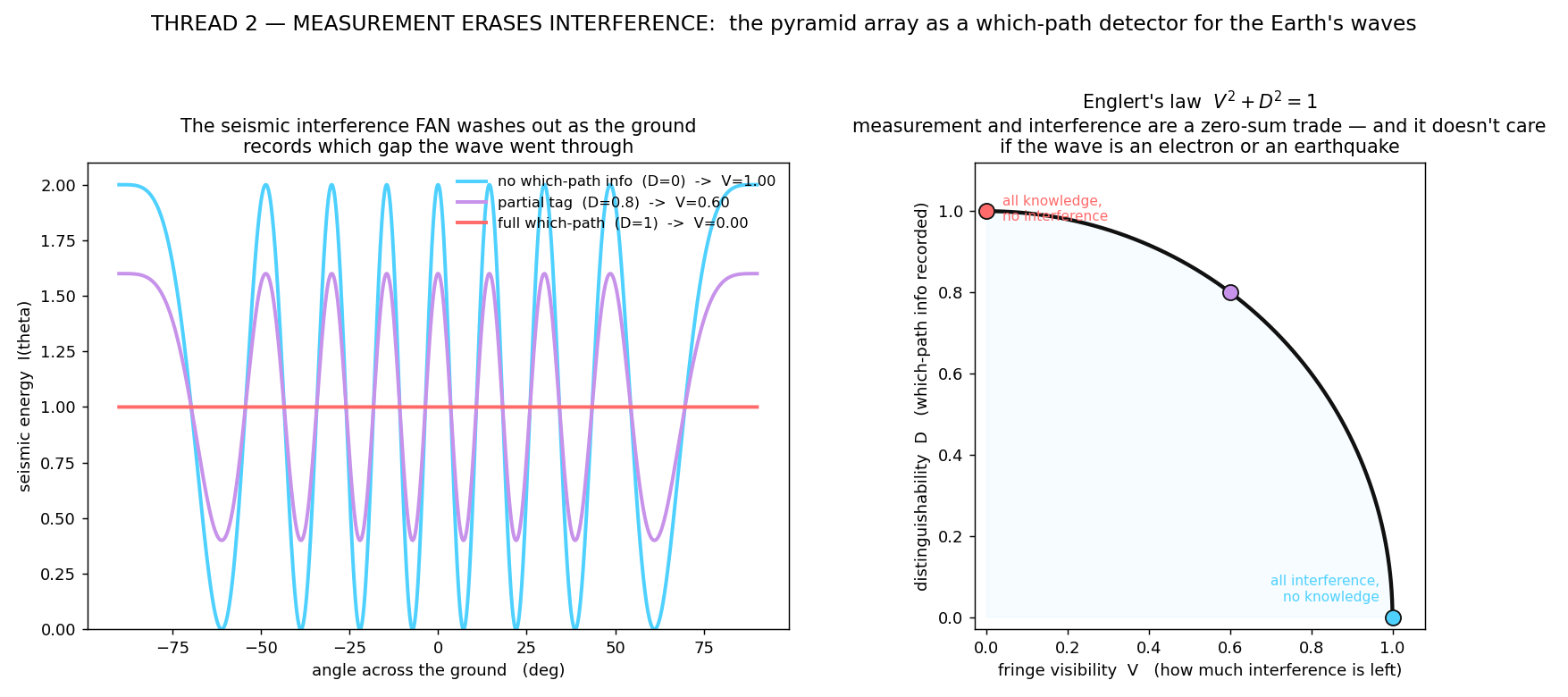
  wrote definiteness_whichpath.png

==========================================================================
THE DEFINITENESS SEAM — what actually makes the world definite
==========================================================================

  THREAD 1 — MASS, NOT MINDS. Objective collapse makes definiteness a real,
  observer-free event whose rate climbs as N^2. The everyday world isn't definite
  because someone looks; it is definite because it is too MASSIVE to stay
  superposed. A dust grain settles in ~10^-8 s, a pyramid in ~10^-57 s, with the
  desert empty. (Honest ceiling: this is a live, being-tested hypothesis, not a
  proven one — see ../participatory_seam. Many-Worlds, in which nothing collapses,
  is still standing.)

  THREAD 2 — MEASUREMENT ERASES INTERFERENCE. The other route to definiteness:
  the environment records which path was taken. Englert's V^2 + D^2 = 1 is
  substrate-independent, so the seismic double slit of ../pyramids_seismic is a
  which-path detector — the more the ground 'knows' which gap the wave used, the
  more the interference fan disappears. No quantum mechanics, no consciousness:
  just information in the rock.

  THE FUSION: 'the pyramids were observed and the Earth's superposition collapsed'
  becomes two honest, quantitative statements — mass makes big things definite,
  and measurement trades interference for which-path knowledge. The watcher was
  never needed. That is the real, deep bottom of the double slit.
Press Run it to execute this script in your own
browser — real CPython, numpy and matplotlib
compiled to WebAssembly. Nothing is sent to us;
it runs on your CPU. First run downloads the
runtime (~10 MB), then takes a few seconds.

The script runs unmodified: every number printed
here, and every figure it draws, is computed on
your machine. The figures appear below.