USR-2026-0027 · CMB
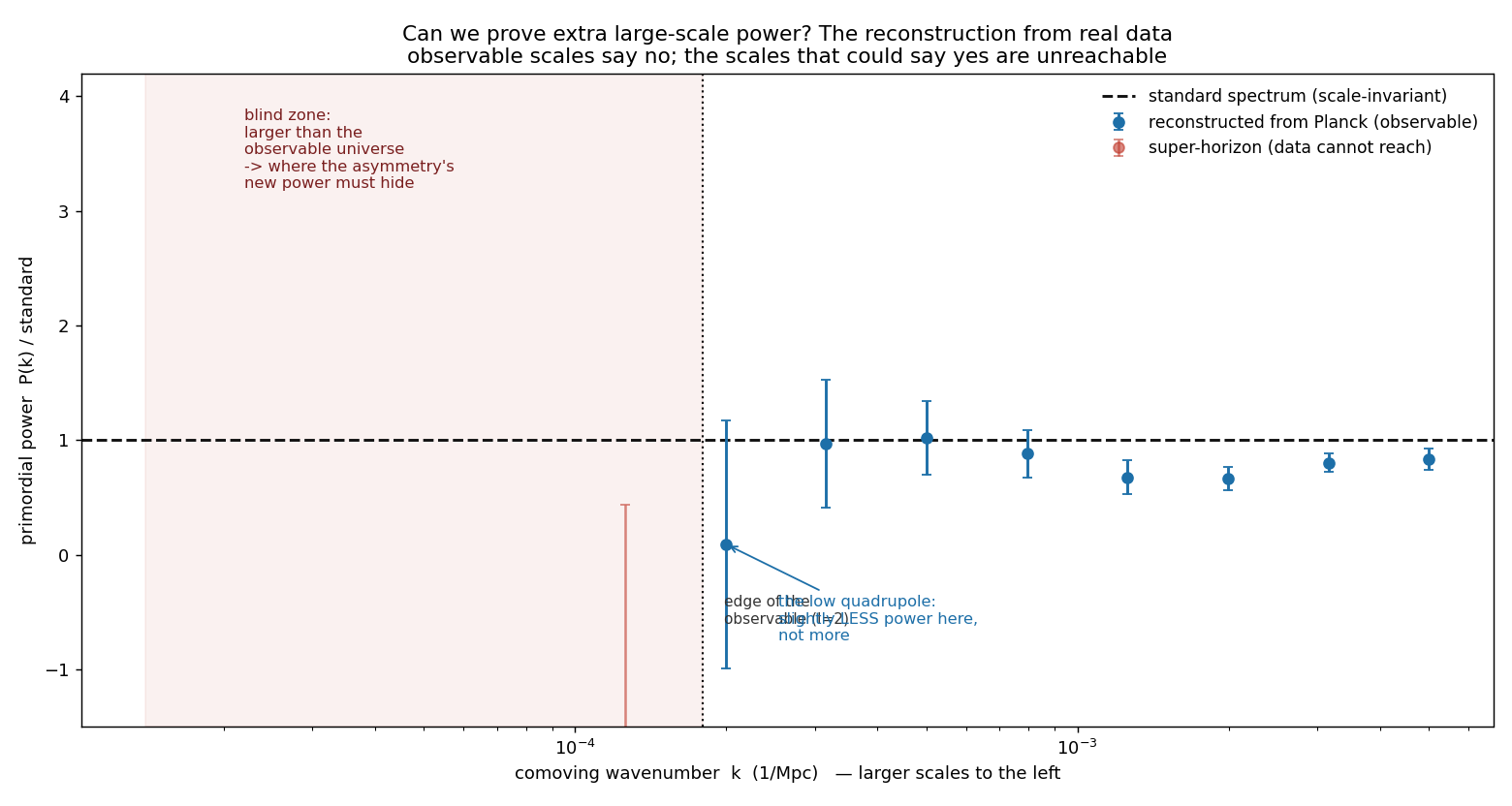
No detection of either excess or deficit on the largest observable scale: P/P_std = 0.09 ± 1.08, i.e. 0.84σ from standard. The data do not require extra large-scale power and cannot exclude up to about 2.2× standard. Below k = 1.5×10⁻⁴ Mpc⁻¹ the reconstruction is formally unconstrained (errors 262% to 142001%).
PROVISIONAL
P/P_std = 0.09 ± 1.08 — 0.84σ from standard, i.e. no detection either way
re-run & confirmed 2026-07-09 (R0 — founder CI; independence pending)
CORRECTED 2026-07-26: 'shows a deficit' over-read the number — 0.09 ± 1.08 is statistically indistinguishable from standard. The knots are also fitted one at a time against overlapping ℓ ranges and are therefore correlated.
Falsify-box — how to kill this claim
UNTESTED
Three limbs, one per assertion in the statement. (a) THE NO-EXCESS BOUND (the claim's load-bearing half): DEAD if a primordial-power reconstruction at the largest observable knot (k = 1.5e-4 Mpc^-1, the l = 2 mode) returns P/P_std >= 2.25 - the 2-sigma ceiling from the claim's own quoted 0.09 +/- 1.08. This limb has already withstood its own search: the signed, unbounded single-knot estimator run on real Planck low-l TT returned 0.09, a full 2.0 sigma below the threshold. (b) THE ASSERTED DEFICIT (open): DEAD if the identical reconstruction run on an independent low-l TT estimate returns a central value P/P_std >= 1.00 at that knot, i.e. the sign of the claimed 'deficit' flips. Named routes: Planck COMMANDER or NILC in place of SMICA; the same map with the Planck common mask and a mask-deconvolved or QML low-l estimator instead of full-sky anafast; WMAP low-l TT. This limb is live for two verified reasons - the quoted point sits only (1.00-0.09)/1.08 = 0.84 sigma from standard, and run_primordial_reconstruct.py line 74 feeds hp.anafast the un-inpainted SMICA I_STOKES (field=0) at NSIDE 32 over the FULL SKY with no mask read at all, so galactic-plane power enters Chat_l at l = 2-40 with full weight. (c) 'UNCONSTRAINED' BELOW k = 1.5e-4 (open, and a statement about the computation rather than about nature): DEAD if the same reconstruction re-run with a different primordial basis - a wider log-normal bump than BUMPW = 0.32, or a smooth spline/PCA basis instead of one-knot-at-a-time bumps - returns super-horizon knot errors below 100 percent, since the quoted 262%-142001% range is a property of the chosen bump width and single-knot fitting, not of the transfer function alone. No CMB temperature or E-mode dataset can physically constrain P(k) below k(l=2), and that should be stated as a bound; but the specific error-bar numbers are a reproducible computation and must be adjudicated as one.
Verification record — every quoted number, re-run 2026-07-09
| quantity | measured | verdict |
|---|---|---|
| largest observable scale | P/P_std = 0.09 ± 1.08 → 0.84σ from standard | MATCH |
| 2σ allowed range | 0 to about 2.25× standard | MATCH |
| super-horizon scales | formally unconstrained (errors 262%–142001%) | MATCH |
| registered framing, superseded | 'shows a deficit' — not supported at 0.84σ | MATCH |
Provenance
script: tilt_seam/run_primordial_reconstruct.py
script status: PRESENT
datasets: Planck low-ℓ TT · claim-scripts (downloadable from /data — run it yourself)
re-run: 2026-07-09
script status: PRESENT
datasets: Planck low-ℓ TT · claim-scripts (downloadable from /data — run it yourself)
re-run: 2026-07-09
Status, honestly
CORRECTED 2026-07-26 by the kill-test sweep; the audit flag it carried is resolved. Status here is computed from evidence — the author cannot set it, and neither can we. Independent reproduction would move it; nothing else will.
§ Figures
1 from tilt_seam/run_primordial_reconstruct.py
What this claim's own script draws. These are the founder's committed outputs — the same plots the script regenerates on any machine that runs it.